
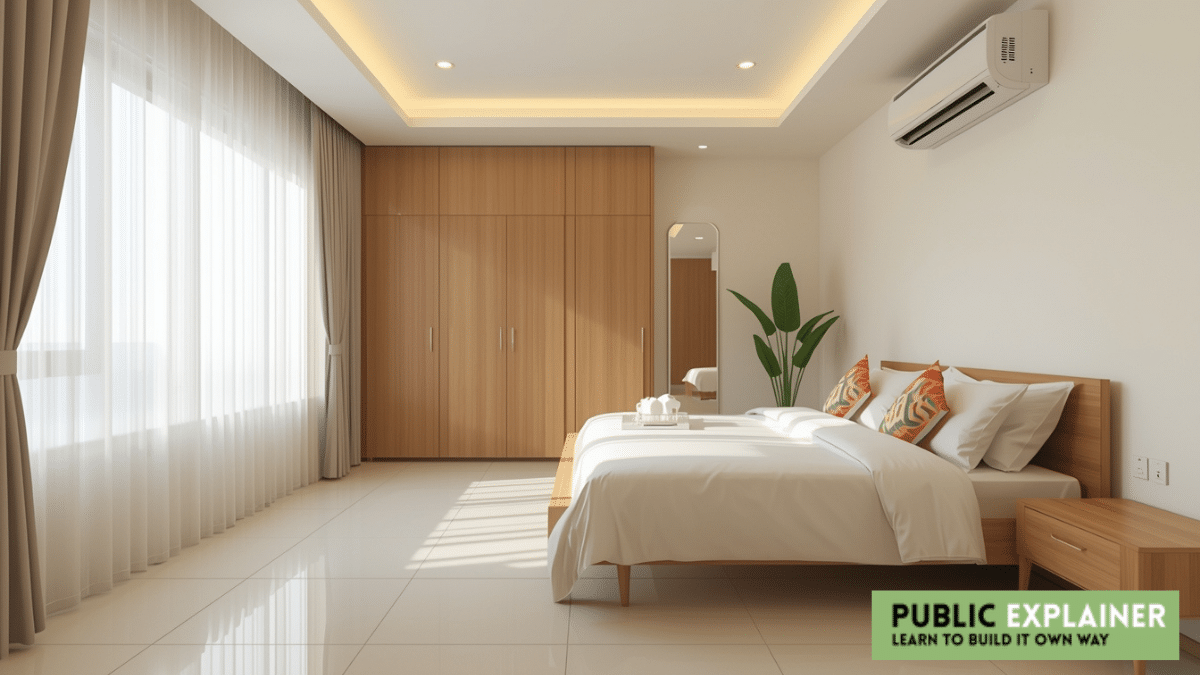
- What is standard bedroom size in Philippines?
- Standard Bedroom Floor Plan (10 ft x 12 ft)
- Furniture Measurements
- Wall Construction Materials and Their Cost
- Flooring Options and Cost
- Ceiling Materials and Cost
- Paint and Finishing Materials
- Electrical Work
- Total Cost Estimate 10 ft x 12 ft Bedroom
- Bedroom Floor Plan Design Tips
- Conclusion:
Bedroom floor plan is essential for building any house, without it, building any house costs more money than necessary or the design of the house gets spoiled, that is why you should first make the bedroom floor plan and then make the house plan.
Some people want to remodel their bedrooms, but they can’t find the right bedroom floor plan, resulting in a poor design. To help solve this problem, Publicexplainer has brought you the best bedroom floor plans all completely free.
You are requested to please read this article carefully and understand how you should design your bedroom.
What is standard bedroom size in Philippines?
First, you should know the size of a typical bedroom. Although budgets vary for different homes in the Philippines, and each home is built according to its land space, there is a standard bedroom size that you should maintain.
And if you want to redesign your old bedroom with a good bedroom floor plan, then we have explained about it below.
Actually, there are three categories of bedrooms, the first one is Small Bedroom whose size is 8 ft x 10 ft. total 80 sq ft 7.4 square meters.
This size is most commonly found in condo units, low cost housing, and Page IBIG funded homes. Bedrooms of this size typically accommodate a bed, a small wardrobe, and a small side table. You can’t do much more with such a bedroom.
The second is “Standard Bedroom” whose size is 10 ft x 12 ft. 120 sq ft or maximum 11.1 square meters.
And this is the most commonly built bedroom type in the Philippines because it provides the space you need and costs less.
This size bedroom can accommodate a double bed, wardrobe, dressing table, and study table. If you need more bedroom space, you can remove the study table or other items.
The third is “Master Bedroom” whose size is 12 ft x 14 ft. 168 sq ft or approximately 15.6 square meters.
This size is seen in the houses of those people who have a little more money, that is, those who are upper middle class people.
However, many people keep a master bedroom in their homes and make the rest of the bedrooms smaller, which is most commonly seen in today’s times.
This type of bedroom accommodates a king-size bed. A large wardrobe, study table, dressing table, etc. can also fit comfortably.
You can also give this type of bedroom any design you desire, but it does cost more. Some people create a sitting area in the master bedroom itself.
But when it comes to money, people’s thinking changes. So, you can compare which bedroom you should build and which one would be best for you below.
Standard Bedroom Floor Plan (10 ft x 12 ft)
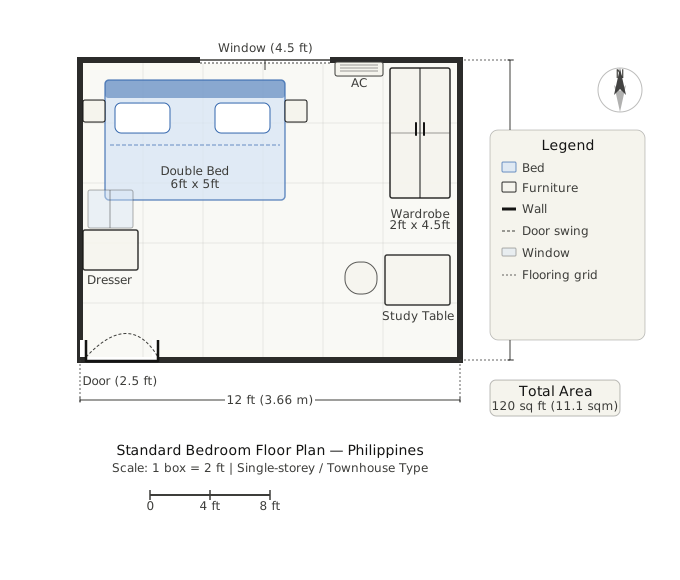 Bedroom Floor Plan
In the Philippines, a 10 ft/12 ft bedroom is considered standard. However, this is the case in almost all countries.
You can see the standard bedroom floor plan given below to see how the furniture is set up in it.
We’ve also provided measurements to make it easier for you to understand. If you have any problems understanding the plan, please let us know in the comments.
The total width of the room is 12 ft, or 3.66 m, and its length is 10 ft, or 3.05 m.
The total floor area of this bedroom is 120 square feet. The ceiling height in the Philippines is 8 to 9 feet. If we calculate this in meters, it is 2.44 to 2.74 meters.
Door sizes are standard, measuring 2.5 ft wide and 7 ft high. This size is used in standard hollow block construction in the Philippines.
The window size is also 4.5 feet wide, which is ideal for natural ventilation and light. This is important, as any window smaller than this would be difficult to live in the Philippines’ hot climate.
If your bedroom is large, you can increase the size of the windows. The larger the windows, the better the natural ventilation. So, decide on the window size wisely. Although you can choose any design.
Furniture Measurements
Now let’s talk about how to setup furniture in this bedroom floor plan and what is its measurement.
First comes the bed, without which a room is incomplete. A double bed measures 6 feet by 5 feet. There must be at least 2 feet of space on both sides of the bed for movement.
And most importantly, the headboard is designed in many ways. Many people place the bed in the middle of the room, making it look awkward. Most often, the headboard is attached to the wall.
If you’re choosing a dresser with a mirror, consider measuring 1.8 ft/4.5 ft. In this plan, we’ve placed it on the left. You can adjust the placement of your home to suit your needs.
But keep in mind that where you want to place the dresser, there should be at least 3 feet of space to stand there.
The size of the study table should be 2ft/2ft or 2ft/2.2ft. However, you’ll need to set aside 2.5ft of space for a chair. You’ll also need to include space for movement, as in this plan.
Apart from this, I have placed bedside tables in this bedroom floor plan whose size is 0.75 ft x 0.75 ft.
Note: The side table should be kept at the same height as the bed and should not be higher than the bed.
Wall Construction Materials and Their Cost
Now let’s move on to wall construction, which is the most expensive part. This is where people often use low quality materials to save money.
Some common materials are used to build walls in the Philippines. Those with the means to afford them can build quality walls. But since we’re ordinary people, I’ve made this plan budget friendly.
Hollow Blocks (CHB)
Hollow Blocks are the most popular construction material in the Philippines. They also save money.
A standard size 4/8/16 inch CHB costs around 12 to 18 pesos in the Philippines. A 10 ft x 12 ft bedroom requires around 400 to 500 hollow blocks, which costs between 5,400 to 9,000 pesos.
Now the question arises: why use hollow blocks? So, folks, Hollow blocks (CHB) are inexpensive and readily available in the local market.
Apart from this, it is also accepted inside the buildings in the Philippines, hence CHB is used in most of the houses.
Concrete and Plastering
Now it is the turn of plastering, it will take approximately 15 bags of Portland cement to plaster 4 walls in a 10 ft x 12 ft bedroom.
The price of a bag of cement can range from 280 pesos to 320 pesos, it varies according to the area.
But the cost of sand is different from that of cement. So, if we combine cement and sand, the cost would be 8,000 to 12,000 pesos. Yes, this includes labor costs, so there’s no need to worry.
Drywall/Gypsum Board
This is an alternative material used mostly for interior partition walls. A sheet is 4/8 feet and costs around 350 to 450 rupees.
A bedroom requires 12 to 15 sheets, so add up the total cost. It’s quick to apply, and the walls look straight and smooth after painting.
However, it lacks strength because it is inherently weak. If you are short on money, you can use it to build interior walls.
Flooring Options and Cost
There are three options for bedroom flooring in the Philippines. Each option has a different cost. You’ll need to choose which option you prefer.
Ceramic tiles
Ceramic tiles are the most commonly used because they look beautiful and are also the best option in terms of strength.
There are thousands of designs available to choose from. If cost is a concern, you can choose 12-inch or 30-cm tiles for a standard-sized bedroom.
The price ranges from 35 pesos to 80 pesos, and sometimes even higher. You can find out by visiting the store.
A 120sq ft bedroom requires approximately 130 to 135 tiles which can cost between 4500 to 10800 pesos.
Labor costs are separate, and there’s no estimate. Because labor rates vary from location to location, you’ll need to ask your local laborer how much they charge for installation.
Still, you can estimate that it will cost you 150 pesos to 200 pesos per square meter.
This is the price charged by our company’s contractor. Consequently, the total labor cost could be up to 2,220 pesos.
Pro tip: Ceramic tiles have the advantage of being very adaptable to the Philippine environment and increasing the durability of your flooring. So, even though they may cost a little more, opt for ceramic tiles.
Homogeneous tiles are stronger and more premium than ceramic tiles, but they cost a little more.
It will cost you 150 to 400 pesos per tile and is also water resistant. It is usually installed in offices with high traffic, but it can also be installed at home.
Vinyl Flooring (Cushion Floor)
This is a budget-friendly option, as it costs between 100 and 250 pesos, and it’s very easy to install.
However, its durability is much lower than that of ceramic tiles. If you’re short on money, you can consider this option. It will cost a little less than ceramic tiles but the strength will be less.
Engineered Wood
This is most commonly found on upper floors in the Philippines. The wood looks premium and adds to the aesthetic appeal of the home.
But it is not as good as you think because there is always a risk of scratches or fire.
If you have children, don’t choose this option. The cost is also high. You can find it for approximately 200 to 600 pesos per square foot.
Even though it looks luxurious, it is not suitable for homes in the Philippines as it requires high maintenance.
Ceiling Materials and Cost
There are a few popular options for bedroom design in the Philippines, and they vary in cost.
Gypsum Board Ceiling
This is the most commonly used option and Gypsum Board ceiling is famous not only in Philippines but all over the world.
The price of a 4 ft x 8 ft Gypsum sheet is 350 pesos to 450 pesos and it varies slightly depending on the area.
A 120 sq ft bedroom ceiling requires approximately 5 sheets, which totals 1,750 to 2,250 pesos. But this is only for simple ceilings.
There will be different cost for different designs, labor cost will also be different which can be around 3,000 pesos to 5,000 pesos.
PVC Ceiling
PVC ceilings are the best option for areas with high humidity. And they’re also inexpensive.
The price of a panel can range from 250 pesos to 400 pesos. A panel measures 4 ft x 8 ft and is lightweight, waterproof, and easy to install.
If you want to make your ceiling in less time then PVC ceiling is the best option. Another option is wood ceilings, also known as Lawanit, which are much cheaper.
It’s readily available in local markets in the Philippines. A sheet can cost anywhere from 180 to 280 pesos. However, it’s best suited for areas with 12-month sunlight.
Paint and Finishing Materials
A 120 sq ft bedroom including four walls and a ceiling, covers approximately 200 sq ft. One gallon (3.79 liters) covers approximately 60 sq ft.
According to this, you need 3 to 4 gallons of paint to paint a 120 sq ft bedroom.
Some popular brands in the Philippines like Boysen or Davies cost between 800 pesos and 1500 pesos per gallon.
This will cost you approximately 2,400 to 6,000 pesos. You’ll also need to apply a primer, which is essential.
A gallon of primer can cost anywhere from 500 to 800. Primers come in different qualities, so it’s up to you which one you use.
Electrical Work
Electrical work is a job that doesn’t have a fixed price. There are many different types of small jobs that can increase or decrease your budget.
Still, I have created this bedroom floor plan keeping in mind the houses of Philippines.
This bedroom will have at least two sockets on either side of the bed. There will also be a light that can be turned two-way.
A ceiling light is also provided, which is essential. A fan point, and if you want to install an AC, a separate 20 amp point is required.
If you want, you can increase the points in it but this will increase the expenses.
In terms of cost, electrical costs for a bedroom range from about 3,000 to 8,000 pesos, depending on the quality of the wire you use.
Note: More points or lighting results in higher electrical bills, hence energy-efficient LED lights are highly recommended.
Apart from this, ceiling fan which costs around 1500 pesos to 5000 pesos, and AC which costs between 18000 pesos to 30000 pesos for 0.75 HP or 1.00 HP, all these expenses are also included in it.
Total Cost Estimate 10 ft x 12 ft Bedroom
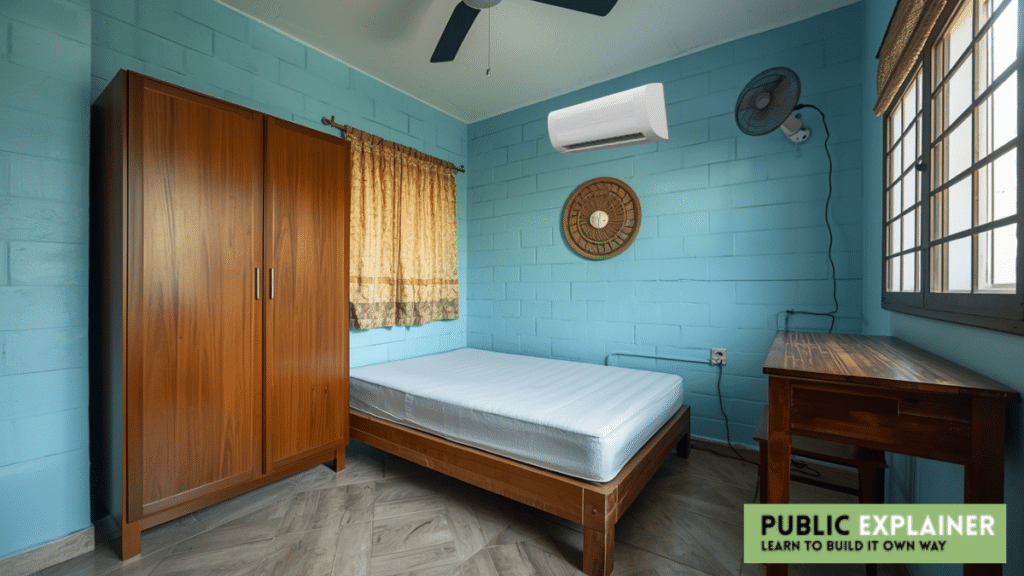 Bedroom Floor Plan
Now let’s combine all of these factors to create an overall cost estimate. This estimate is for construction costs only; furniture is not included.
Walls (hollow blocks + plastering) can cost 20,000 pesos to 35,000 pesos. Flooring (ceramic tiles + labor) costs 15,000 pesos to 25,000 pesos.
Ceilings (Gypsum board + Labor) cost 8,000 pesos to 15,000 pesos. Paint and finishing costs 5,000 pesos to 10,000 pesos. Doors and windows cost 8,000 pesos to 20,000 pesos. Electrical work costs 5,000 pesos to 12,000 pesos.
Total estimated construction cost: 61,000 pesos to 117,000 pesos (Approximately PHP 60,000 to 120,000). This estimate includes materials and labor and is for just the bedroom space.
Furniture should be budgeted between 25,000 and 80,000 pesos, depending on the quality. A complete bedroom set consisting of a bed, wardrobe, dresser, and study table can be found in the Philippines for 25,000 to 60,000 pesos, for mid-range quality.
Bedroom Floor Plan Design Tips
There are certain things to keep in mind when designing a bedroom in the Philippines. Typhoon-proofing is crucial. Typhoons occur regularly here, so windows should have sturdy frames, preferably aluminum or uPVC.
Sliding windows are preferable to awning-type windows, as they can remain slightly open even during rain without waterlogging.
Humidity control requires proper ventilation and the use of moisture-resistant materials. Humidity in the Philippines ranges from 70 to 90 percent, so cement board or moisture-resistant gypsum board is more appropriate.
Maximizing natural light is crucial because daylight savings are not observed in the Philippines, and in the summer, it’s bright as early as 6 a.m. South-facing windows are flooded with light throughout the day.
Storage space is typically small in homes in the Philippines, so built-in storage should be maximized. Under-bed storage, built-in wardrobes, and wall-mounted shelves are great ways to make space efficient.
Balikbayan Feel Whether you’re an OFW or returning from abroad, the modern minimalist style is very popular in the Philippines. Neutral colors like off-white, beige, and light brown are great for walls, and wood-finish furniture creates a warm look.
Conclusion:
So friends, let me know how you liked today’s bedroom floor plan in the comments below. Also, let me know what kind of design you’re going for. If you have any questions, you can ask me on Instagram. I’ve included the profile link below.
What is Standard bedroom size in Philippines?
The standard bedroom size in the Philippines typically ranges from 10 to 16 square meters, though in smaller homes and condos, it can be as compact as 6 to 9 square meters.
How to design bedroom in Philippines tropical climate?
It is essential to prioritize good ventilation, large windows, light color schemes, and airflow to ensure the room remains cool.
Which layout is best for condo bedroom?
For condo bedrooms, a compact layout featuring sliding doors, multi-purpose furniture, and an open-plan design works best.
How to place bed in bedroom?
It is generally best to position the bed against a wall and opposite the door to facilitate easy movement within the room.
Does bedroom floor plan typically include a study area?
Yes particularly in the Philippines, a small study desk can be incorporated into a corner of the room, especially for students.
How to create budget bedroom floor plan?
A great design can be achieved even on a limited budget by utilizing simple layouts, locally sourced materials, and DIY furniture.
Which floor plan is best for a kids bedroom?
For a child’s room, priority should be given to open space, storage solutions, and safety features.

Comments (1)
Very good information